

Searching for a piano mover nearby is not just about finding a truck with an open appointment. A piano can weigh more than 500 pounds, has a delicate finish and internal mechanism. And may need different handling depending on whether it is an upright or a grand. For a Los Angeles-area move, the right company should explain how your instrument, access points, stairs, distance, and destination will affect the plan and quote.
The best piano movers near me are local specialists who use trained crews, appropriate protective equipment. And binding flat-rate quotes so you can plan the move without hidden fees or surprise upcharges.
Before comparing estimates, look beyond proximity. A trustworthy mover should be able to describe its experience with piano transport. Provide a clear process for evaluating your home, and answer practical questions about protection and responsibility. Those details matter because even a short local move can place unusual stress on a heavy, top-heavy instrument.
Why Piano Moving Needs Specialists, Especially for a Local Move
A piano is not simply another large piece of furniture. Its weight, shape, balance, and sensitive internal components create risks that can be easy to underestimate when the destination is only a few miles away. A move from one Los Angeles neighborhood to another may still involve narrow hallways, stairs. Uneven walkways, tight turns, or a loading route that changes the demands of the job.
Many pianos exceed 500 pounds. Illinois State University classifies equipment over 500 pounds as heavy equipment and specifically includes pianos, organs, and harpsichords among the musical instruments that require specialized handling. That classification matters because a crew needs to match its equipment and manpower to the instrument, rather than relying on general-purpose lifting techniques.
Weight is only part of the challenge
Pianos are also difficult to control. Their weight is not distributed like that of a rectangular cabinet, and their cases can be vulnerable to pressure, impact, and uneven movement. A rushed lift or an improperly secured instrument can damage the exterior, affect the legs or pedals, or put unnecessary stress on the internal action and soundboard. A local route reduces driving time, but it does not remove those risks during loading, transport, unloading, or placement.
Safe planning starts with the actual conditions at both properties. A qualified crew should consider the piano type, its approximate weight, door and stair dimensions. Floor surfaces, clearance around corners, and whether an elevator or other suitable aid is needed between levels. Equipment also has design limits. Illinois State’s guidance emphasizes that the weight being moved should not exceed the safety limit of the hoist, dolly, or other equipment used.
Why standard movers may not accept the job
Some general moving services exclude pianos from standard contracts. Buffalo State’s moving guidance explains that pianos require special equipment, are unusually susceptible to damage, and require tuning after every move. The same concern applies to organs and harpsichords, which can be heavy, delicate, and difficult to handle without the right preparation.
That is why choosing specialized piano moving experience is important even for a short local relocation in Los Angeles, Orange, Riverside, or Ventura County. The right provider evaluates the route before moving day and uses a process built around the instrument, not just the mileage.
Answer capsule: A local piano move still requires specialist equipment, trained handling, and route planning because the instrument is heavy, delicate, and unusually vulnerable to damage.
How to Find Piano Movers Near Me You Can Trust
When comparing piano movers near me in Los Angeles, look beyond a polished website and a low starting price. A dependable company should be able to explain who will handle your piano. How the route will be assessed, what protection applies during transit, and exactly how the price is determined. Those answers matter whether you are moving an upright across town or coordinating a more complicated grand piano relocation.
Confirm the company is qualified and accountable
Ask for proof of licensing and insurance before you book. The company should also explain its coverage for high-value instruments, not simply point to a standard household-goods policy. Specialized cargo insurance can provide more appropriate protection for a piano while it is being handled and transported. Request the coverage details in writing, including any exclusions, deductibles, or declared-value requirements.
Then ask who will arrive at your home. A direct moving provider with its own trained, background-checked employees can give you a clearer line of accountability than a company that simply coordinates an unfamiliar crew. Neatly Moving & Storage operates with its own professional crews and owned equipment, supporting specialty logistics for sensitive items. You can learn more about its specialized piano moving approach before requesting an estimate.
Look for a detailed estimate, not a vague promise
A trustworthy mover should ask useful questions before quoting the job. Expect to discuss the piano type, dimensions, stairs, narrow hallways, elevators, gates, driveway access, parking, and both pickup and delivery conditions. A remote review may be convenient, but an in-home or virtual consultation should still produce a specific plan for the move.
For local moves, ask whether the quote is flat-rate and binding, and have the company identify every service included. Clarify whether stairs, protective equipment, travel between addresses, waiting time, or difficult access could change the total. Transparent pricing should not depend on vague hourly assumptions or surprise fees added after the crew arrives. Neatly’s flat-rate, binding quote model is designed to keep the cost predictable and communication clear.
Finally, verify that the company regularly serves your part of Southern California, including the relevant areas of Los Angeles, Orange, Riverside, or Ventura County. A local specialist should be able to discuss realistic coordination for your addresses and explain how the move will be tracked from planning through delivery. For broader household relocation support, review these local moving services.
Answer capsule: Choose piano movers near me who are licensed and insured, use trained in-house crews. Carry suitable coverage for high-value instruments, inspect both locations, and provide a written flat-rate, binding quote with no hidden fees.
Upright vs. Grand Piano Moving: What Changes
Both upright and grand pianos are heavy, delicate instruments, but their shapes and weight distribution create different handling challenges. An upright is taller and narrower, while a grand extends outward with a broad frame and a lid that must be protected. Those differences affect the crew’s plan, equipment, and access review.
For Los Angeles homeowners, the route matters as much as the piano. Tight hallways, stairs, elevators, gates, driveways, and curb access can change the safest approach. A professional mover should assess these conditions instead of treating a piano like ordinary furniture.
| Consideration | Upright piano | Grand piano |
|---|---|---|
| Weight and shape | Tall, compact body with weight concentrated vertically; still heavy and top-heavy. | Wide, longer body with an uneven profile and substantial weight across the frame. |
| Crew size | Often requires a coordinated specialty crew sized for the piano and the route. | Usually needs more hands and tighter coordination because of its length and balance. |
| Equipment | Piano board, straps, padding, and an appropriate piano dolly or skid may be required. | Needs the same protection, plus specialized skids, boards, and frame support. |
| Disassembly | May involve securing or removing limited components when access requires it. | Legs, pedals, music desk, and other removable components commonly need careful preparation and protection. |
| Main cost factor | Access, stairs, distance, weight, and preparation usually drive the estimate. | Handling time, protection, disassembly, access, and structural support can increase the estimate. |
| Skill level | Requires movers trained to control a top-heavy instrument without stressing the cabinet or internal mechanisms. | Requires specialized piano-moving experience, especially on turns, stairs, or restricted openings. |
Piano boards, straps, and protective padding matter for both styles because pianos are top-heavy and delicate. The crew should also confirm that the weight does not exceed the safety limits of the dolly, hoist, or other equipment being used. Grand pianos need significantly more specialized handling and structural support than uprights, especially when the route includes stairs or narrow access points. The safest plan is based on the instrument and the property, not on a one-size-fits-all moving package.
Direct takeaway: An upright may need less equipment and time, but both piano types require specialty handling. Grand piano moves generally demand additional crew coordination, disassembly, protection, and structural support.
What a Professional Piano Move Actually Involves
A professional piano move starts well before the instrument reaches the truck. During the pre-move assessment, the crew reviews the piano type, approximate weight, dimensions, doorways, stairways, elevators, flooring, and both pickup and delivery locations. This planning identifies tight turns, changes in level, and surfaces that need protection. It also helps the company determine whether the available crew and equipment are appropriate for the job. Guidance from Illinois State University emphasizes that trained manpower and suitable moving equipment should be confirmed before heavy equipment is moved. And that the load must remain within the equipment’s design safety limits (Illinois State University moving-safety guidance).
That assessment matters because pianos are heavy, top-heavy, and delicate. They often exceed 500 pounds, which places them in the heavy-equipment category. A professional crew does not treat an upright piano like an ordinary piece of furniture or assume that a short local move is automatically low risk.
The equipment and crew work together
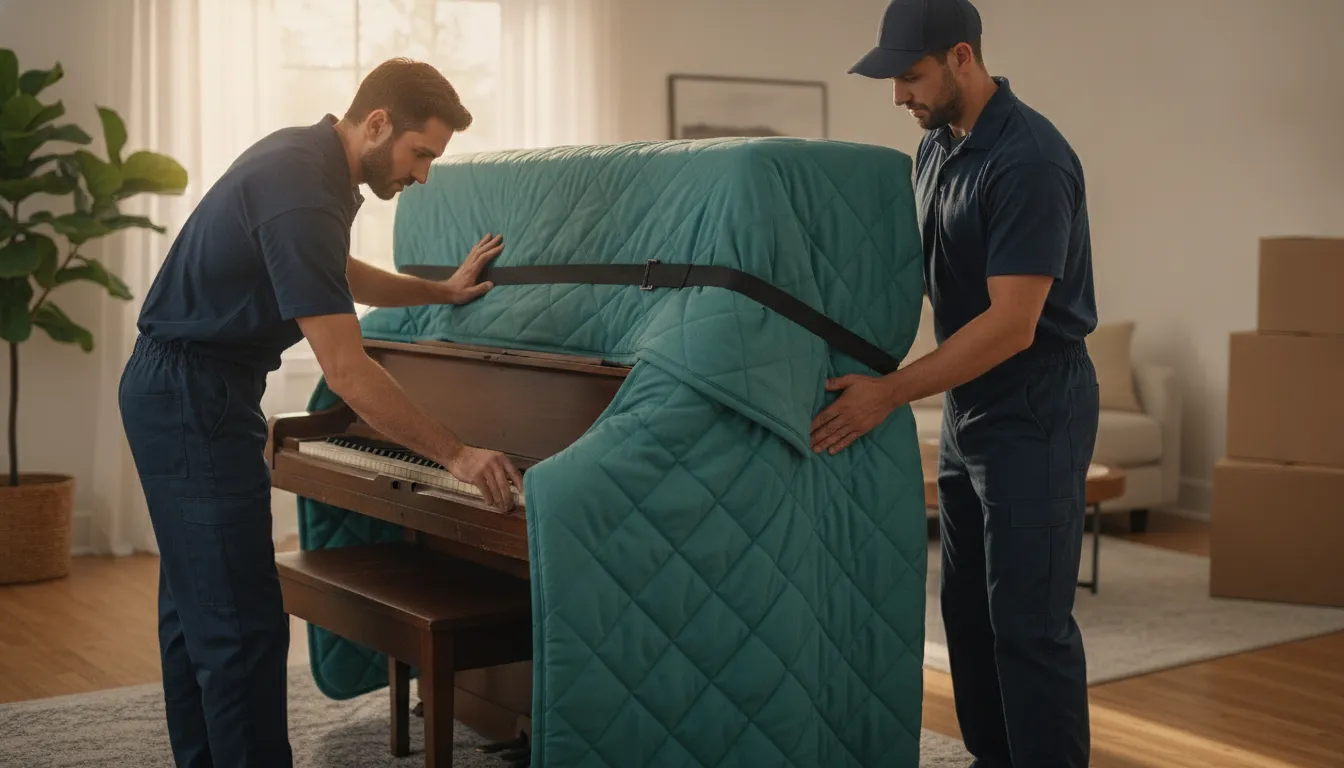
The right equipment protects both the instrument and the people handling it. Depending on the piano and the route, movers may use a piano board, heavy-duty straps, protective padding, and specialized piano dollies. Padding helps shield the cabinet and finish, while boards and straps help stabilize the instrument during positioning and loading. Dollies must be selected and used with the piano’s weight and the route in mind. If the move involves stairs or another level change, suitable aids such as an elevator, hoist, or forklift may be necessary rather than relying on uncontrolled lifting.
Equipment alone is not enough. A trained crew must coordinate each movement, communicate clearly, protect the home, and maintain control of the piano through narrow passages and transitions. Before choosing piano movers near me, verify that the company can explain its equipment, crew experience, and plan for unusual access conditions. A direct provider with its own trained crews can also give clearer accountability than a loosely coordinated handoff.
Typical steps in a professional move
- Inspect the piano, route, access points, and surfaces at both locations.
- Confirm crew size, equipment, weight limits, and any elevator or stair requirements.
- Pad and secure the piano before carefully positioning it on the appropriate dolly or board.
- Move, load, and transport the instrument with controlled handling and securement.
- Place and level the piano at its destination, then arrange professional tuning after the move.
Transport can affect an instrument through handling and environmental changes. Buffalo State notes that pianos require tuning after every move, so tuning should be treated as a normal follow-up, not an optional repair (Buffalo State moving-services guidance).
Direct takeaway: A safe piano move combines a documented route assessment, trained manpower, weight-appropriate equipment, controlled transport, and post-move tuning. If a mover cannot explain each part, keep comparing your options.
How Flat-Rate Quoting for a Piano Move Keeps Costs Predictable
A piano move should not begin with a vague hourly promise and end with a bill that bears little resemblance to the first conversation. Moving a piano can involve stairs, narrow doorways, long carries, specialized equipment, extra protection, and careful coordination at both addresses. If those details are not considered before moving day, the customer may face surprise upcharges when the crew arrives.
A flat-rate quote creates a clearer agreement from the start. The mover reviews the piano, the access conditions, the distance, and the handling requirements, then provides a binding written estimate for the planned work. That gives you a specific price to compare and a practical opportunity to ask questions before scheduling. It also makes it easier to distinguish experienced piano movers near me from companies that advertise a low starting rate without explaining what the final service may include.
What a transparent piano-move quote should include
An accurate estimate should account for the piano’s type and size, the route from the current room to the vehicle. Stairs or elevators, parking and carrying distance, and the equipment needed to protect and transport the instrument. A professional assessment is especially important because pianos are heavy, top-heavy, and delicate. Industry guidance identifies pianos as heavy equipment that often exceeds 500 pounds and emphasizes matching the load to the safety limits of the moving equipment. Illinois State University’s heavy-equipment guidance explains why this planning matters.
Neatly Moving & Storage uses in-home or virtual consultations to gather those details before the move. The consultation lets the team discuss access points and service expectations rather than relying on an incomplete description. Neatly is a direct service provider with its own trained professional crews and fleet of equipment. And its flat-rate model is designed around clear pricing with no hidden fees. Those details matter when a piano requires specialty logistics, not a generic moving estimate.
Why hourly or low-ball quotes can become expensive
Hourly pricing is not automatically dishonest, but it transfers more uncertainty to the customer. A difficult stairway, a delayed elevator, an unexpected carry, or additional protection can extend the clock. A low introductory quote can create the same problem if important services are excluded until the day of the move. With a binding flat-rate estimate, the price is tied to the agreed scope instead of changing simply because the job takes longer than expected under ordinary conditions.
Direct takeaway: Choose a piano mover that inspects the job in advance and gives you a binding flat-rate written estimate. A transparent scope, trained crew, and no-surprises pricing make the cost easier to plan and the move easier to trust.
The Cost of Hiring Piano Movers Locally
Local piano moving is often less expensive than a long-distance shipment, but it is not priced like carrying a few boxes across town. As a broad planning range, piano moves may cost from roughly $610 to more than $1,000, depending on the instrument and the route. Those figures are not guarantees. A careful quote must account for the actual piano, both properties, and the conditions crews will face.
The piano itself is one of the first cost variables. An upright generally requires less labor and structural support than a grand piano. A grand may need additional protection, preparation, and handling because of its shape, weight distribution, and delicate components. Pianos are often heavy equipment exceeding 500 pounds, so the crew also needs equipment whose design limits safely accommodate the load. Illinois State University safety guidance emphasizes the importance of suitable equipment and trained personnel when moving heavy items.
Access and distance can change the estimate
The mileage between addresses matters, but it is only part of the route. A piano that moves directly from a ground-floor room to a nearby home may require fewer labor hours than one traveling through narrow hallways. Tight turns, elevators, or multiple flights of stairs. Stairs, balconies, steep driveways, limited parking, and long carries from the truck can all affect the crew size, equipment, and time required.
That is especially important in Los Angeles and Southern California, where hillside homes, dense neighborhoods. Apartment buildings, controlled-access communities, and varied street access can make two nearby moves very different. Disassembly and reassembly may also be needed for some grands or for pianos that cannot clear a doorway safely. Before accepting a quote, describe the piano type, dimensions if available, floor levels, stairs, elevators, parking, and any narrow access points. Photos or a virtual walkthrough can help the mover identify conditions that a quick phone estimate might miss.
Why the lowest estimate may not be the lowest cost
Hourly pricing or a low initial estimate can appear attractive. But the final bill may rise when access takes longer, extra protection is required, or the route presents unexpected complications. A flat-rate, binding quote based on a real assessment gives you a clearer basis for comparison. Neatly Moving & Storage provides flat-rate quotes designed to avoid hidden fees, with in-home or virtual consultation options for planning the move.
Direct takeaway: Plan on a few hundred to over a thousand dollars for a local piano move. Then request a binding flat-rate quote that reflects the piano, access conditions, distance, and any disassembly. That is the best way to replace guesswork with a realistic cost.
How to Prepare for Your Piano Move
A little preparation helps the moving crew work safely and prevents avoidable delays on moving day. Start by walking the piano’s full route, from its current position to the truck. Remove furniture, toys, rugs that can slide, wall decor, and other obstacles from the path. Make sure the crew can reach the piano with the equipment they need. Including a clear approach for a piano dolly and enough room to position the truck near the entrance.
Measure every potential pinch point before the move. Check doorways, hallways, stair landings, elevators, gates, and tight turns, and note low ceilings or raised thresholds. Measure the piano at its widest and tallest points, then compare those dimensions with the available clearance. Share the measurements and photographs with the estimator if an in-home visit is not possible. Stairs and landings deserve special attention because a piano is top-heavy and cannot be treated like an ordinary box.
Protect the route and the instrument
Protect floors and doorways before the crew arrives. Use sturdy floor runners or boards where appropriate, and protect corners, trim, and door frames from contact with moving equipment. Do not rely on thin household blankets alone for a heavy instrument. Specialized piano boards, straps, and protective padding are essential because pianos are delicate and top-heavy. Learn more about the equipment used for piano moving.
Close and secure the keyboard cover and piano lid according to the instrument’s design. Remove sheet music, lamps, metronomes, decorative objects, pedals that are not permanently attached, and anything stored inside the bench. Do not place loose items on top of the piano during transport. If the lid or keyboard cannot be secured safely, tell the crew in advance rather than improvising with household tape or rope.
Share access details before moving day
Tell the moving company about every stair flight, narrow turn, sloped driveway, gate, parking restriction, elevator requirement, and unusual surface between the pickup and delivery locations. Also disclose whether the piano is an upright, baby grand, or grand, and provide its approximate dimensions. This information allows the crew to plan the right equipment and staffing. Moving heavy equipment between levels requires suitable aids, not improvised lifting, and equipment must stay within its design safety limits.
If the piano cannot go directly into the new room, ask about a secure interim plan. Storage services may be relevant when access, renovations, or closing dates create a gap. For a nearby household relocation, review Neatly’s local moving services and provide complete access details when requesting a flat-rate estimate.
Direct takeaway: Clear and measure the entire route, protect floors and doorways, secure every loose piano component, and disclose stairs or tight turns before the crew arrives.
Frequently Asked Questions
How much do piano movers cost?
A local piano move often costs about $610 to $1,050, depending on the piano type, travel distance, stairs, tight access points, and other handling requirements. The most reliable way to compare prices is to request a detailed quote based on your actual pickup and delivery conditions. Neatly Moving & Storage provides flat-rate, binding quotes so the agreed price is clear before the move begins.
What equipment is needed to move a piano?
Professional crews typically use a piano board, heavy-duty straps, protective padding, and suitable dollies or other lifting equipment. The crew should also confirm that the equipment’s safety limits match the piano’s weight and the route. This matters because pianos are top-heavy, delicate, and often weigh more than 500 pounds. Illinois State University safety guidance identifies pianos as heavy equipment requiring specialized handling.
Do I need special piano movers for a grand piano?
Yes. Grand pianos require more specialized handling and structural support than upright pianos because of their size, shape, and exposed legs and pedals. A qualified crew should discuss the piano’s dimensions, the path through each property, stairs or elevators, and any narrow turns before giving a price.
How do I find reputable piano movers near me?
Look for a direct moving company with trained crews, appropriate insurance, experience with specialty instruments, and a clear written quote. Ask who will perform the move, what protection is included, and how difficult access affects the plan. An in-home or virtual consultation can help the company identify risks before moving day. Neatly Moving & Storage serves customers across Los Angeles and surrounding Southern California counties.
Can any moving company transport a piano?
Not necessarily. Many standard moving services exclude pianos because they require specialized equipment and are unusually susceptible to damage. Confirm that the company accepts piano moves and has the equipment and trained personnel required for your specific piano and route before booking.
Ready to Plan Your Piano Move?
A clear plan can make a local piano move easier to coordinate, especially when access, equipment, and the instrument’s size all need attention. Neatly Moving & Storage can help you take the next step with an in-home estimate tailored to your move.
Get an in-home piano move estimate from Neatly Moving & Storage


