

A piano is not simply another piece of furniture. An upright can weigh hundreds of pounds. While a grand combines exceptional weight with delicate components that can be damaged by an awkward lift, tight stairway, or poorly secured trip. Protecting it starts before the first mover touches the instrument.
Professional piano movers assess the piano and route, use specialty equipment and layered padding, and secure each instrument for the specific demands of the move. For Southern California homeowners, Neatly Moving & Storage provides trained employee crews, specialized handling, and transparent flat-rate pricing designed to avoid surprises.
That preparation matters whether the piano is crossing town in Los Angeles County or traveling farther from a home in Orange, Riverside, or Ventura County. Neatly has even handled instruments owned by John Lennon, Vanessa Williams, and Kimora Lee Simons. Before discussing equipment and protection, it helps to understand why this work deserves experienced professionals rather than an improvised moving plan.
Get a free piano moving quote from Neatly Moving & Storage today and our team will walk through the equipment, protection, and pricing for your instrument.
Why Hire Professional Piano Movers
A piano is both heavy equipment and a delicate instrument. An upright may weigh 200 to 800 pounds, while a grand piano can weigh 500 to 1,200 pounds or more. Concert grands may reach 1,300 pounds. The cast-iron plate inside the instrument can account for roughly 70% of its total weight, according to piano weight and moving guidance from Savvy Pianist.
That weight is concentrated in a large, difficult-to-grip object with vulnerable legs, pedals, finish, soundboard, and internal action. A move that looks manageable in an open room can become hazardous at a doorway, on a staircase, or across an uneven surface.
Why DIY piano moving can damage your home and instrument
Without the right technique, a piano can shift unexpectedly, tip, or place too much pressure on one leg or caster. That can damage the cabinet, loosen structural components, scratch the finish, or harm the internal parts that produce the instrument’s sound. Even when the piano arrives without visible damage, rough handling and vibration may create problems that are costly to diagnose and repair.
The home is also at risk. Floors, thresholds, walls, door frames, and stairs can be damaged when people try to control hundreds of pounds with improvised straps or an undersized dolly. A helper who loses footing can be pulled into the piano or pinned beneath it. The risk increases when a move involves stairs, tight turns, limited clearance, or a truck ramp.
Professional heavy-equipment policies, including Illinois State University’s handling guidance, emphasize specialized planning and equipment to protect both the item and the surrounding facility. That principle applies in a residence as well. A piano should not be treated like another boxed household item.
What trained piano movers do differently
Trained, employed crews assess the piano, route, access points, flooring, and stairs before deciding how to move it. They use purpose-built padding to protect the finish, sturdy dollies to distribute the load. And skids or boards when the instrument must be tilted, maneuvered, or secured for transport. The crew coordinates each movement rather than relying on one person to steer while others push.
Choosing hire professional piano movers also gives you an opportunity to confirm the company’s process, crew experience, and protection terms before moving day. For a high-value instrument, ask how the piano will be wrapped, what equipment will be used, how stairs will be handled, and what happens if damage occurs. Federal consumer resources also recommend reviewing a mover’s liability and protection information before transportation, as explained by the Federal Motor Carrier Safety Administration.
Answer: Professional piano movers reduce injury and property damage risk by combining trained coordination, specialized padding. Dollies, skids, and safe handling techniques that general movers or a DIY team may not have.
How Do Professional Piano Movers Protect Your Piano?
Protection begins before the piano leaves its room. Professional piano movers inspect the instrument, measure the route, and identify tight turns, low clearances, uneven surfaces, and stair access. That planning determines which equipment and crew positions are needed, rather than leaving a heavy, delicate instrument to chance.
The piano is first wrapped in soft padding that protects its finish from scratches and scuffs. Foam corner protection adds another layer at the points most likely to contact a doorway, wall, or other surface. Heavy-duty moving blankets then cover the instrument securely. The padding is held in place so it does not shift while the piano is being tilted, rolled, or carried.
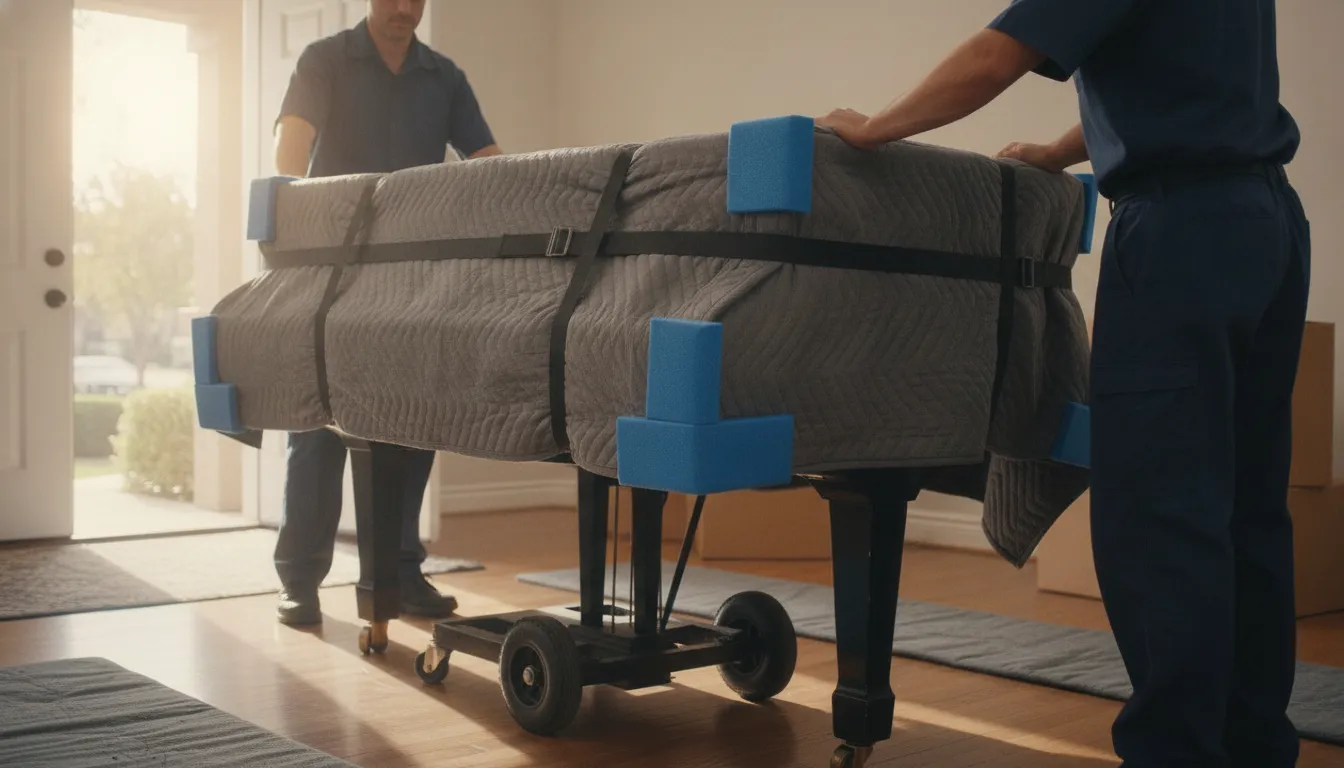
Specialized equipment keeps the piano stable
Movers use piano skids and purpose-built dollies to support the instrument and distribute its weight. These tools make controlled movement possible while reducing unnecessary strain on the piano’s legs, casters, and cabinet. A piano should never be dragged across flooring or moved by relying on its decorative wheels alone. If the route includes stairs, the team plans each transition carefully and uses appropriate ramps, straps, and lifting positions.
Neatly Moving & Storage has specialized equipment for piano transport and can also help with specialized moving services for heavy items. Its employed, background-checked crews are trained to handle specialty pieces with care. That direct, professional approach matters when the item being moved is both difficult to replace and central to a home.
Securing the piano for the drive
Once loaded, the piano is positioned to minimize movement and secured inside the truck with straps and other appropriate restraints. The crew checks that the instrument cannot roll, tip, or shift during acceleration, braking, and turns. Blankets and padding remain in place throughout the trip, and the team handles unloading with the same care used during loading.
Storage requires additional attention. The location should be suitable for the instrument, and the piano should remain protected during placement, retrieval, and any transfer between spaces. If your move includes a temporary stay, ask about piano storage and how the instrument will be handled at each stage.
Answer capsule: Professional piano movers protect your instrument by planning the route, using soft padding, foam corners. Heavy-duty blankets, skids, dollies, ramps, and restraints, then securing the piano carefully in the truck and storage area.
Moving an Upright vs a Grand Piano
Upright and grand pianos both require careful planning, but their size, shape, and center of gravity create different moving challenges. The instrument’s weight is only one part of the equation. Crews also need to account for doorways, stairs, turns, flooring, and the safest way to support the piano during transport.
According to Savvy Pianist’s piano weight guide, uprights can weigh about 200 to 800 pounds, while grand pianos commonly weigh 500 to 1,300 pounds or more. Those ranges vary by model, so trained piano movers assess the specific instrument and the route before deciding on equipment and staffing.
| Consideration | Upright piano | Grand piano | Effect on the move |
|---|---|---|---|
| Typical weight | About 200 to 800 pounds | About 500 to 1,300 pounds or more | Heavier instruments may require additional crew members, stronger ramps, and more route planning. |
| Transport orientation | Moves upright, often tilted slightly with the back supported. | Moves horizontally on a piano board or skid. | The crew must control the instrument’s center of gravity while protecting its cabinet, soundboard, and internal components. |
| Equipment | Piano dolly, protective padding, straps, ramps, and floor protection. | Piano board, skid, heavy-duty dolly, padding, straps, ramps, and floor protection. | Specialty equipment reduces shifting and helps the crew navigate narrow halls, steps, and thresholds. |
| Key handling differences | May need controlled tilting to place it securely on a dolly. | Legs and the pedal lyre are removed before securing the piano to its board. | Disassembly and reassembly must be performed carefully so parts are protected and returned to the correct position. |
| Route planning | Height and narrow clearance are common concerns. | Width, weight, turning space, and overhead clearance are often more demanding. | The crew may need to measure openings, protect walls, and choose a different path before loading begins. |
A professional crew does not handle a grand piano like an oversized upright, or an upright like ordinary furniture. Trained piano movers know how to secure each design, protect finished surfaces, and coordinate the lift so the instrument stays stable. That preparation helps reduce avoidable damage to the piano and the home.
Answer capsule: Uprights usually travel vertically with controlled tilting, while grands are partially disassembled and transported horizontally. The right equipment and handling plan depend on the piano model and the moving route.
What Does It Cost to Hire Professional Piano Movers?
The cost of moving a piano depends less on a single standard rate than on the work required at each location. A professional quote should account for the instrument, the route, the access conditions, and any added handling or storage needs. That is why a careful piano moving company asks detailed questions before presenting a price.
What factors affect the price?
Piano size and weight are important starting points. An upright and a grand piano require different equipment, positioning, and handling techniques. The condition of the instrument and whether it can be moved through the planned route also matter. A large or unusually heavy piano may require additional crew members or specialized equipment to keep it stable and protect the instrument and home.
Access at the origin and destination can have just as much impact. Movers may need to plan for flights of stairs, narrow halls, tight turns, elevators, uneven walkways, or a long distance between the truck and the door. Stairs and difficult approaches increase the time and care required to protect floors, walls, doorways, and the piano itself. Clearing pathways and sharing accurate access details early can help prevent surprises on moving day.
Travel distance is another major consideration. A local move within Southern California is priced differently from an interstate relocation because the crew, mileage, scheduling, and transportation requirements change. If the piano will be held between homes, ask how piano storage affects the scope. Storage preparation, loading, unloading, and the length of time in storage should be clearly addressed before work begins.
Timing can also influence availability and planning. A last-minute request, a narrow delivery window, or a move that must happen outside normal scheduling may require a different crew and logistics plan. Providing the piano type, pickup and delivery addresses, stair information, photos, and preferred dates helps the mover build a more accurate quote.
Why a binding, flat-rate quote matters
Neatly Moving & Storage uses a transparent flat-rate model. The binding quote is the price you pay when the scope remains the same, rather than an open-ended starting figure that can grow through unexpected add-ons. Before accepting, confirm that the quote reflects the piano type, access conditions, travel distance, storage needs, and requested timing. You can also review common planning questions in Neatly’s moving FAQs.
Answer capsule: Piano moving costs vary with the instrument, access, distance, storage, and timing. A detailed binding quote gives you a clear price and helps prevent surprise charges when the agreed scope does not change.
Are Piano Movers Insured for High-Value Instruments?
Yes, reputable piano movers should be able to explain their liability protection and valuation options before they handle your instrument. That conversation matters because a piano is both heavy and mechanically sensitive. A dropped corner, damaged finish, bent pedal, or shift in the internal action can create repair costs that are not obvious until the instrument is inspected and played.
For interstate household-goods moves, federal rules require movers to provide consumers with clear information about their liability options. The Code of Federal Regulations, 49 CFR Part 375, covers consumer disclosures and responsibilities for household-goods carriers. The Federal Motor Carrier Safety Administration explains that moving companies must provide information about the levels of liability protection available for a move.
What should you confirm before moving a piano?
Ask the mover to explain, in writing, what protection applies to your piano during loading, transportation, unloading, and any temporary storage. Confirm whether the estimate includes released-value protection, full-value protection, or another valuation arrangement, and ask what exclusions, deductibles, claim deadlines, and documentation requirements apply. Do not assume that a general statement such as “we are insured” answers those questions. The policy or valuation paperwork should identify the protection that applies to your specific shipment.
It is also useful to document the piano before the crew arrives. Take dated photographs of the cabinet, legs, pedals, lid, music desk, and any existing marks. Record the make, model, serial number, and condition of visible components. If the instrument has unusual value, recent restoration work, or sentimental importance, ask whether an appraisal or other supporting documentation is appropriate. Share access details in advance as well, including stairs, tight turns, elevators, gates, and parking limitations. Accurate information helps the mover plan the work and reduces avoidable handling risks.
How does Neatly approach high-value moving?
Neatly Moving & Storage uses trustworthy, employed crews rather than sending customers to unknown laborers. The team can plan specialty handling around the instrument and the home, communicate the scope clearly, and provide a binding quote when the agreed scope stays the same. Before booking, ask the coordinator to walk through the protection terms and valuation choices in plain language. A transparent estimate should make it easier to understand what is included, what is optional, and what you need to do if a concern arises.
Answer capsule: Piano movers should clearly explain liability protection and valuation options before the move. Confirm the terms in writing, document the instrument, and choose a crew with the training and equipment to handle a high-value piano carefully.
Should You Tune Your Piano After Moving?
Yes. Scheduling a professional tuning after a move is a sensible part of caring for your piano, even when the instrument arrives without visible damage. Transport places the piano under physical stress, and the temperature and humidity conditions at the new home may differ from those at the old one. Those changes can affect the strings, soundboard, and other components that work together to produce a stable tone.
A piano can also need time to settle after it has been carried, secured, loaded, unloaded, and positioned in its new room. Moving the instrument does not automatically damage it when experienced professionals use the right equipment and handling methods. However, the move can leave the piano sounding slightly sharp, flat, or uneven. A tuning gives a qualified technician the opportunity to bring the instrument back into balance and identify any adjustment it may need.
When should you schedule the tuning?
Plan to have the piano tuned roughly two to four weeks after the move. This waiting period allows the instrument to adjust to its new environment before the technician makes precise corrections. A room with noticeably different humidity, a strong heating or cooling system, or substantial seasonal changes may make settling especially important.
Keep the piano away from direct sunlight, exterior doors, vents, radiators, and other sources of rapid temperature change while it settles. If you notice a new mechanical problem, unusual buzzing, sticking keys, or a visible concern, contact a piano technician sooner rather than waiting for the scheduled appointment. A tuner can distinguish normal post-move adjustment from a problem that needs attention.
It is helpful to arrange the appointment before moving day, particularly if local technicians have limited availability. Share the piano’s type, approximate age, and any concerns you noticed during delivery. If the piano will remain in storage, ask both your piano storage provider and tuner about temperature and humidity conditions before planning the final tuning.
Answer capsule: Have your piano tuned about two to four weeks after a professional move so it can settle into its new temperature and humidity conditions. The move itself should not damage the instrument when trained piano movers handle it properly.
Source: Living Pianos explains why a piano may need tuning after it is moved.
Book your piano move with Neatly Moving & Storage to receive a flat-rate estimate and a handling plan tailored to your piano and property.
Frequently Asked Questions
How much does it cost to hire professional piano movers?
The cost depends on the piano type, its size and weight, the distance, stairs, tight turns, and the access conditions at both locations. A binding quote should clearly state the planned scope so you know what you will pay when those conditions remain unchanged.
Can I move a piano myself or do I need piano movers?
For most homes, professional piano movers are the safer choice. Pianos are heavy, delicate instruments that require specialized equipment and handling techniques. Trained crews can protect the instrument, floors, walls, and doorways while managing stairs and confined spaces. The FMCSA consumer advisory also recommends understanding your rights and responsibilities before hiring a mover.
How do professional piano movers protect my instrument during transport?
Movers typically secure the piano with heavy-duty padding, protective blankets, foam corner protection, and specialized skids or dollies. They plan the route in advance, protect surrounding surfaces, and use appropriate equipment for stairs and tight spaces. The piano is then secured in the vehicle to limit shifting during transport.
What is the difference between moving an upright and a grand piano?
An upright piano generally remains vertical and may need controlled tilting to protect its back and casing. A grand piano requires a different process, often including removal of the legs and pedal lyre. Careful support on a piano board, and protection for the lid, strings, and action. Its larger footprint also changes the route and equipment plan.
Do I need to tune my piano after hiring piano movers?
Usually, yes. Changes in temperature, humidity, and transportation stress can affect tuning. A piano technician commonly tunes the instrument about two to four weeks after the move, allowing it time to adjust to its new environment. See this post-move tuning guidance for additional context.
Ready to Book Piano Moving?
Professional piano moving helps protect a valuable instrument while making the logistics easier for your household. Neatly Moving & Storage can help you plan the right handling approach for your piano and property. Book piano moving with Neatly Moving & Storage to discuss your move and request the next steps.


